
Expressvpn Glossary
Network traffic analysis
What is network traffic analysis?
Network traffic analysis is the process of examining data as it moves between devices on a network. It’s used to understand how systems communicate and to spot security or operational issues.
Once a baseline is established, unusual traffic becomes easier to spot. These deviations may indicate an attack, a misconfiguration, or a violation of network policy.
How does network traffic analysis work?
Network traffic analysis works by examining copies of network communications without interfering with the original data flow. Traffic is collected using Test Access Points (TAPs) or Switched Port Analyzer (SPAN) ports that mirror data from physical network links. Virtual monitoring features can also be used in cloud environments.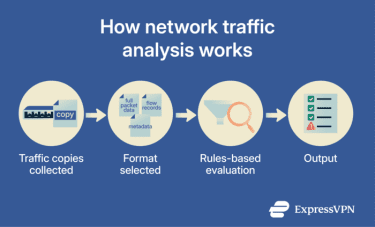 The copied traffic is commonly analyzed in three main forms: full packet data, flow records, and metadata. These differ in how much detail they provide and how they are used.
The analysis process then pieces together the sequence of communications from captured data. It evaluates them using detection rules, statistical comparison, and analysis of how devices and services normally communicate.
This identifies activity linked to known threats or deviations from normal operation. The results appear as alerts and logs used for investigation and monitoring.
Types of network traffic analysis
- Packet-based analysis: Captures full copies of network transmissions. This provides the highest level of detail but requires significant storage and processing.
- Flow-based analysis: Records connection summaries of which systems communicated, when connections started and ended, and how much data was exchanged.
- Metadata-based analysis: Examines selected attributes, such as domain names queried or the type of encryption a connection used.
- Signature-based detection: Compares traffic against databases of known malicious indicators.
- Behavior-based analysis: Compares current traffic to established patterns of normal network activity.
Why is network traffic analysis important?
Network traffic analysis provides visibility into how systems interact across a network. Endpoint tools can show what happens on a single machine, but network data shows how activity spreads between systems and beyond the network boundary. That’s useful for:
- Identifying communication issues between internal systems.
- Recognizing repeated connections to external servers that may be controlling compromised devices.
- Detecting unusually large or prolonged data transfers that may suggest unauthorized data removal.
Traffic records also help verify that network controls, such as firewall rules and segmentation, are working as intended by showing whether traffic is being allowed or blocked. During security incidents, these records provide a timeline of which systems communicated and when, helping establish the sequence of events.
Where is network traffic analysis used?
- Security operations centers (SOCs): To monitor network activity, investigate alerts, and review traffic history during threat hunting and incident response.
- Enterprise networks and data centers: To understand communication between users, servers, and services. It also helps confirm that network controls like segmentation and firewall rules are working as intended.
- Cloud networks: To observe traffic between virtual systems, since physical monitoring devices can't be placed inside cloud infrastructure.
- Internet service providers: To manage large-scale network operations, including abuse detection, routing troubleshooting, and capacity planning.
- Operational technology and industrial networks: To track communications between control systems, sensors, and equipment. Unexpected connections or traffic changes may signal misconfiguration, intrusion, or machine faults.
Risks and privacy concerns
- Exposure of personal data: Captured traffic may contain login credentials, personal messages, financial details, or confidential business communications. Even when encryption protects the content, the stored data becomes valuable to attackers.
- Metadata reveals behavior: Even without accessing message content, metadata shows who communicated with whom, when, how often, and for how long. This alone can identify individuals and reveal sensitive patterns.
- Retention increases exposure: The longer captured data is stored, the greater the risk of that storage being breached. Organizations must balance investigative needs against the potential for exposure.
- Legal and compliance requirements: Laws governing network monitoring vary by jurisdiction. Some regions require employee notification or consent, while others restrict what data can be collected or how long it can be retained.
- Encryption limits visibility: Modern encryption prevents inspection of message content in most traffic. This protects privacy but also means traffic analysis increasingly relies on metadata and behavioral patterns rather than content.
Further reading
- Deep packet inspection (DPI): How it works and why it matters
- What is VPN detection, and how does it work?
- Ingress and egress: Everything you need to know