
Expressvpn Glossary
Mesh networking
What is mesh networking?
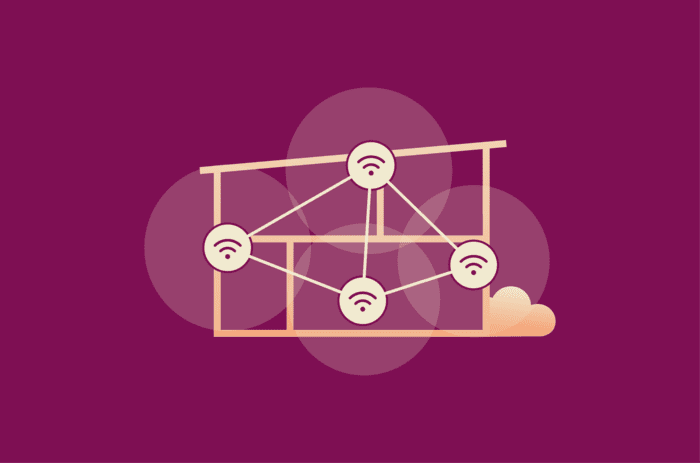
Mesh networking is a network topology in which multiple devices, called nodes, connect directly to one another to form a distributed network.
Instead of relying on a single central router, each node can send, receive, and relay data. This allows traffic to move across multiple paths, improving coverage and reducing reliance on any single point of failure.
How does mesh networking work?
In a mesh network, each node communicates with nearby nodes and forwards data to its destination.
Routing protocols determine the most efficient path based on factors such as signal strength, distance, and network congestion. If a node becomes unavailable, traffic is automatically rerouted through alternative paths.
This ability to dynamically adjust routes is often called self-healing.
Full mesh vs. partial mesh
In a full mesh network, every node connects directly to every other node. This provides high redundancy but requires more connections, making it more suitable for specialized environments where reliability is critical.
In partial mesh networks, nodes connect to selected neighboring nodes rather than all nodes. This reduces complexity and costs while still maintaining multiple paths for data. Most home networks and enterprise mesh systems use this model.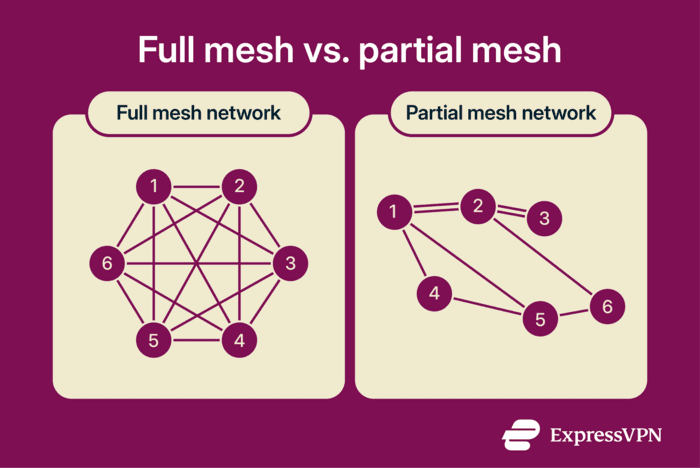
Mesh networks vs. traditional networks
Traditional networks typically use a hub-and-spoke model, where all devices connect through one central router.
Mesh networks distribute that function across multiple nodes. As a result, network operation doesn’t depend on a single device, and connectivity can continue even if individual nodes fail.
Why is mesh networking important?
Mesh networking addresses limitations that traditional router setups cannot solve at scale:
- Coverage: Additional nodes extend network reach without long cable runs.
- Reliability: Multiple paths reduce the impact of node or link failures.
- Scalability: Nodes can be added incrementally as coverage needs grow.
- Resilience: Automatic rerouting maintains connectivity during disruptions.
- Dynamic load balance: The routing algorithm distributes traffic across nodes to prevent congestion and maintain performance.
Where is mesh networking used?
Mesh networking, whether full or partial, is used in environments where consistent coverage and reliability are important:
- Home Wi-Fi: Improves coverage in large or multi-story buildings.
- Smart homes and Internet of Things (IoT): Connects many low-power devices across a wide area.
- Enterprise networks: Provides wireless coverage across offices and campuses.
- Community networks: Extends connectivity in underserved or rural areas.
- Military and emergency response: Supports temporary, field operations communication networks where fixed infrastructure is unavailable.
Security and privacy considerations
Mesh networking introduces specific security considerations due to its distributed design:
- Increased attack surface: Each node is a potential entry point to the entire network if not properly secured.
- Inter-node traffic exposure: Nodes constantly exchange data. Weak encryption on that traffic exposes the network to man-in-the-middle (MITM) attacks.
- Authentication risks: Poor credential management increases the likelihood of unauthorized access.
- Wireless vulnerabilities: Mesh networks are susceptible to interception, interference, and denial-of-service (DoS) attacks.
- Management interfaces: Cloud-based or remote management systems may introduce additional risk if misconfigured.
Further reading
- What is a mesh network and how does it work?
- What is network mapping? Complete guide
- How to boost Wi-Fi signal at home to get faster internet
- What are IoT networks? A complete guide
- What is IoT connectivity, and how do you choose the right solution?