
Expressvpn Glossary
Hybrid cloud security
What is hybrid cloud security?
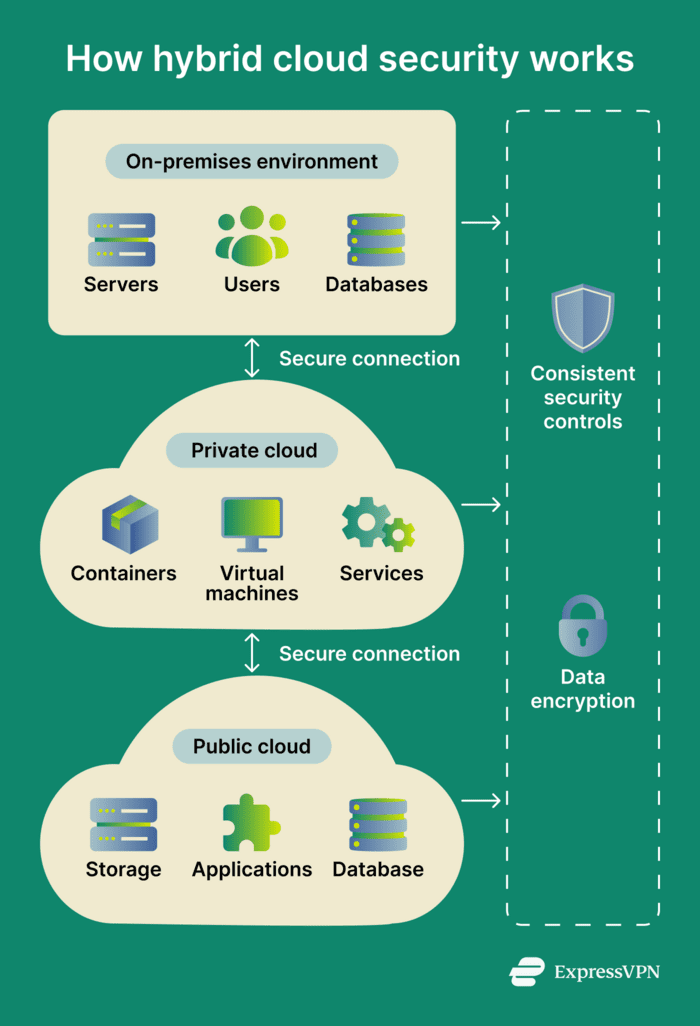
Hybrid cloud security is the set of tools and practices used to protect data, applications, and infrastructure that run across a mix of on‑premises environments, private clouds, and public clouds, including the connections between them.
It aims to maintain consistent access controls, configuration standards, monitoring, and data protection across environments to reduce security gaps.
How does hybrid cloud security work?
Hybrid cloud security combines core controls from on-premises and cloud environments into a coordinated approach:
- Identity and access management (IAM): Centralizing authentication and authorization using role-based access control (RBAC) and multi-factor authentication (MFA) so access is limited to approved users and services.
- Data protection and encryption: Encrypting sensitive data at rest and in transit between environments, supported by consistent key management and access controls for encryption keys.
- Network security: Using segmentation and zero-trust access controls to restrict traffic between environments and limit lateral movement if a system is compromised.
- Unified monitoring and security information and event management (SIEM): Collecting logs and security signals from all environments into a central view to support threat detection, investigation, and audit reporting.
- Consistent security policies: Applying the same security requirements across on-premises systems and public cloud services (for example, encryption rules, configuration baselines, and compliance controls).
- Shared responsibility model: Cloud providers secure infrastructure; organizations protect applications, identities, and data.
Why is hybrid cloud security important?
Hybrid cloud environments increase complexity and the attack surface because workloads and data operate across different platforms with different tooling, defaults, and control panels. Common challenges include:
- Misconfiguration risk: Differences between on-premises and cloud configuration models can create exposed services or overly broad permissions.
- Inconsistent access controls: Identity sprawl and uneven privilege management can leave gaps across environments.
- Visibility gaps: Monitoring and logging may be split across platforms, making threats harder to detect and investigate.
- Data movement exposure: Transfers between environments can increase exposure without consistent encryption, key controls, and access enforcement.
Hybrid cloud security addresses these risks by applying consistent policies, protecting data in transit, and centralizing monitoring. It supports operational resilience by enabling threat detection and response across the full infrastructure. For regulated industries, it also helps maintain compliance when sensitive data is stored or processed across multiple systems.
Where is it used?
Hybrid cloud security applies to any organization running workloads across private infrastructure and public cloud services. Common use cases include:
- Gradual cloud migration: Organizations moving workloads to the cloud in stages while maintaining existing on-premises systems.
- Regulated industries with data residency requirements: Sectors such as healthcare, finance, and government that store sensitive data locally while using public cloud services for other workloads.
- Variable traffic applications: Hybrid environments allow systems to scale into the public cloud during periods of high demand
- Distributed teams: Workforces that require reliable access to applications and data across multiple locations.
- Disaster recovery: Organizations replicate systems between environments to maintain operations if one infrastructure fails.
Further reading
- Security concerns in cloud computing and how to address them
- What is cloud networking? A comprehensive overview
- What is a virtual private cloud (VPC)?
- Zero-trust cloud security explained
- Attack surface reduction explained: Principles, techniques, and tools