
Expressvpn Glossary
Datastore

What is a datastore?
A datastore is a repository where applications and systems store and retrieve data. Unlike temporary memory, a datastore typically persists data beyond a single session or process.
In modern environments, cloud providers offer datastores as a service, handling infrastructure, scaling, and availability. Organizations can use storage resources without managing the underlying hardware.
How does a datastore work?
Applications and services write data to the datastore, which stores information such as user records, files, logs, and transactions. The datastore organizes this data using structures such as tables, key-value mappings, object metadata, or indexes to support efficient retrieval.
Applications retrieve data through queries or APIs, which return specific records or objects based on defined parameters. Access controls and policies determine which users or services can read, write, or modify stored data.
To maintain availability, datastores may replicate data across multiple systems or locations. This ensures continued access if one component fails.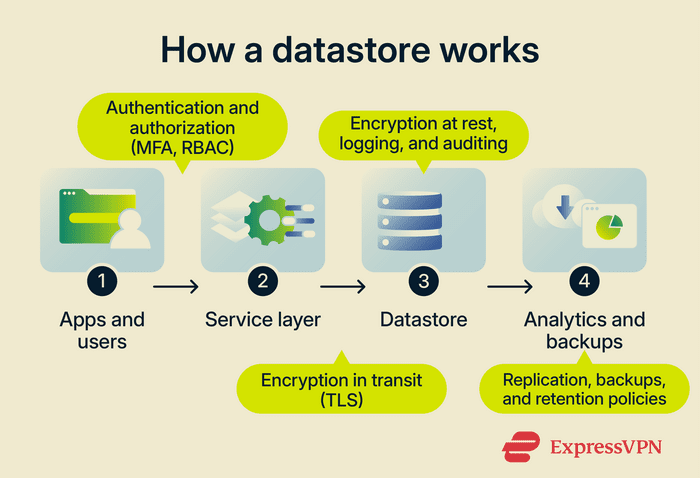
Types of datastores
Datastores come in different forms, each suited to specific workloads and data models. Common examples include:
- Relational databases: Store structured data in tables composed of rows and columns. They use Structured Query Language (SQL) to define, manage, and query relationships between records.
- Not only SQL (NoSQL) databases: Designed for flexible data models and horizontal scalability. Depending on the implementation, they store data as key-value pairs, documents, wide-column records, or graphs.
- Data warehouses: Optimized for large-scale analytics. They aggregate data from multiple sources and support complex queries for reporting, business intelligence, and trend analysis.
- Object storage: Manages data as discrete objects, each containing the data itself and metadata, enabling efficient retrieval in distributed environments. Often used for files, media, backups, and unstructured content at scale.
- In-memory stores: Keep data in system memory rather than on disk. This design enables low-latency access and is commonly used for caching, session storage, and real-time applications.
Where are datastores used?
Datastores appear anywhere systems need to keep information available, searchable, and consistent across sessions, for example:
- Web and mobile applications: Applications use datastores to persist user profiles, preferences, content, and transactional records, ensuring consistent responses across devices and sessions.
- Identity and authentication systems: Identity platforms store user directories, credentials, and session-related data to support sign-in, access decisions, and account management.
- Logging, telemetry, and monitoring: Systems generate large volumes of event data. Datastores hold logs and telemetry so teams can investigate incidents, troubleshoot failures, and track performance trends.
- Content and media hosting: Object storage stores files such as images, videos, and static site assets, which are typically delivered to end users via a content delivery network (CDN) or web server.
- Business intelligence (BI) and analytics: Warehouses and analytics-oriented datastores support reporting and large-scale querying across integrated datasets.
Why datastores matter
The primary role of datastores is to preserve information and make it accessible across modern digital systems.
They also help prevent data loss and corruption through redundancy, replication, backups, and recovery features. By storing copies of data across multiple systems or locations, a datastore can continue to operate even if hardware fails or a component becomes unavailable.
Indexed storage structures and analytics-optimized systems allow applications and organizations to query large datasets efficiently, enabling fast retrieval and reporting.
Datastores also support scaling and centralized governance. As data volumes grow, distributed architectures allow systems to expand capacity while maintaining consistent access controls and management policies.
Datastores form a core part of secure system design. Access controls, policy enforcement, and data management practices depend on how information is stored and protected at rest and in transit.
Risks and privacy concerns
Datastores concentrate valuable information, which makes them attractive targets for cybercriminals. Here are the most common risk factors and their consequences:
- Misconfigured access: Improperly configured permissions or publicly accessible storage can allow unauthorized users to view or download data.
- Weak encryption: If data is not adequately protected at rest or in transit, attackers may intercept or extract sensitive information.
- Excessive privileges: Accounts, service keys, or API credentials with more permissions than necessary can allow attackers who compromise them to access far more data.
- Poor logging: Without proper logging and monitoring, suspicious activity may go undetected, delaying response and increasing damage.
- Unnecessary data retention: Storing data longer than necessary expands the volume of information exposed if a datastore is compromised.
Further reading
- What is big data security and privacy?
- What is a data warehouse? A complete guide
- What is IaaS? Infrastructure-as-a-Service explained
- What is network-attached storage (NAS)?
- What is access control? How it works and why it matters